Turnline: Relaxing Puzzle
Rotate line tiles, connect the square and circle endpoints, and finish every required branch.
- Session
- Relaxed puzzle levels
- Controls
- Click or tap a tile to rotate
- Best for
- Relaxed
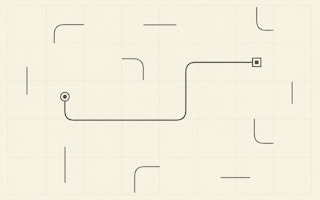
Rotate the complete network
Turnline: Relaxing Puzzle
Click or tap a tile to rotate
Play loads a game hosted by GamePix that may show ads and use cookies.
Provided by GamePix. Ads and cookies may load only after you press Play. Read the GamePix Privacy and Cookie Policy.
Find the square and circle endpoints and inspect border constraints.
How to play
How to Play Turnline: Relaxing Puzzle
Find the endpoints, rotate forced edge pieces first, and connect every required section without leaving loose line ends.
- 01
Locate the square and circle endpoints. Trace the grid cells that could connect them and identify any isolated line fragments that must join that route.
- 02
Tap or click a tile to rotate it. Watch the move counter and the tile's new openings before rotating again.
- 03
Start with forced placements along edges and corners. A line opening that points outside the playable grid is usually impossible unless it is a designated endpoint.
- 04
Extend from already highlighted or clearly connected sections. Match each open line end with a neighboring tile that can accept it.
- 05
Check branches from the outside inward. Every required arm needs a valid continuation, and no ordinary tile should finish with a loose end.
- 06
Use Restart when many early assumptions conflict. Use a Hint when one uncertain region remains and you want a targeted correction.
- 07
Complete the full network, then review which forced clues made the board easier before advancing to the next level.
About the game
Rotate scattered line tiles into one continuous network
Turnline: Relaxing Puzzle presents a grid of line fragments, corners, branches, and endpoints. Tapping a tile rotates it. Your goal is to connect the required network into one continuous chain between the square and circle markers. Correctly connected paths highlight as the board moves toward a complete solution.
The first puzzles introduce the rule with small boards, while later levels add larger layouts, branches, multiple paths, and more intricate arrangements. The interface shows the current level and move count, with Restart and a limited Hint button available. The useful challenge is to reduce uncertainty before rotating rather than spinning every tile until something happens.
Starting level 1 and tapping the board changed the move counter from 00 to 01, confirming that each rotation is recorded immediately. The opening instruction says to connect every line into one continuous chain between the square and circle. Exact starting orientations vary by level, so use endpoints, tile shapes, and highlighted connections as evidence for each board.
Controls
Controls for Turnline: Relaxing Puzzle
- Click / tap a tile
- Rotate that line tile.
- Restart
- Return the current level to its starting orientation.
- Hint
- Reveal limited help for the current puzzle.
- Menu
- Return to the level menu and settings.
Useful strategy
Solve forced borders first and leave flexible centers for later
- Begin at the square and circle. Endpoints have one connection, so their neighboring direction limits the next tile immediately.
- Reject edge orientations that point outside the board. This removes options without spending moves on random trials.
- Count openings on each tile. Straight pieces, corners, and branches serve different roles and cannot replace one another in every cell.
- Follow highlighted connections, but check the entire path. A correct local link can still lead into a dead end farther away.
- Leave central crossroads flexible until the outer paths are known. Branch tiles often need to serve several regions at once.
- Rotate deliberately. Repeatedly cycling one tile consumes moves and makes it harder to remember which orientation was already tested.
- Use Restart when contradictions appear across several areas. Rebuilding from forced clues is clearer than preserving a board full of guesses.
- Spend hints on a specific uncertainty, such as a central branch or two equivalent routes, rather than before reading the borders.
Start from the square and circle endpoints
Endpoints provide the strongest clues because each has only one open side. Find the neighboring cell in that direction and determine which of its orientations can receive the line. This creates a verified beginning at both ends instead of one uncertain path growing across the whole board.
Extend one or two tiles from the square, then do the same from the circle. If both partial routes approach the same region, the remaining gap becomes easier to analyze. If they head toward different branches, inspect whether a junction tile must connect them later.
Do not force the endpoints into the visually shortest route without checking all required fragments. The official goal is the complete network, so side branches and highlighted sections may need to join the main chain before the level recognizes completion.
Use borders and corners to eliminate impossible rotations
A normal line opening should connect to another tile, not point beyond the board. Along the top edge, any upward-facing opening is suspect; the same rule applies to left, right, and bottom boundaries. Corners combine two restrictions and often reveal a tile's only useful orientation.
After fixing an edge tile, inspect its inward neighbor. One confirmed opening creates a new requirement, allowing constraints to propagate toward the center. This is more reliable than rotating central pieces first, where every direction initially looks possible.
Some edge cells may not belong to the final network if the board allows blank space, so confirm that a visible line fragment actually needs connection. The useful rule is not that every cell must point inward, but that every required line end must meet a compatible neighbor or endpoint.
Delay flexible branches until their incoming paths are known
Branch tiles have several openings and can satisfy multiple neighborhoods, which makes them tempting early targets. Their flexibility is more valuable later. First determine which surrounding paths must reach the branch, then rotate it once to accept those confirmed directions.
When two possible routes compete for one branch, trace both to their next forced tile. A route that immediately hits a border, loose end, or incompatible corner can be rejected. Use global continuity rather than judging a branch only by the cells beside it.
After rotating a junction, inspect every arm. It is easy to connect the main square-to-circle route while leaving one side branch loose. Highlight feedback helps, but manually check each visible opening before assuming the full network is complete.
Control the move count and use hints with a clear question
Every tile rotation increments the move counter. A low count is easier when you decide the target orientation first. If a corner needs two clockwise turns, make those turns directly instead of cycling through all four orientations while reconsidering.
Restart is useful when several guesses interact and the board no longer communicates which placements were evidence-based. Before restarting, remember the forced endpoint and border orientations. Rebuilding those verified pieces quickly produces a cleaner position for the unresolved center.
The Hint control is limited, so use it after narrowing the problem. Ask a specific question: which way should this central branch face, or which of two corridors is part of the required network? One targeted hint can then unlock further deductions instead of replacing the whole puzzle.
Keep a simple mental record of tiles that are already proven. An endpoint neighbor is proven when only one orientation can receive its line without pointing outside the grid. A border piece is proven when every other rotation creates a loose edge. Avoid touching those tiles while testing the center. If a later contradiction appears, return to the first unproven junction instead of dismantling the verified outer route. This separates deduction from experimentation and makes each extra move useful: either it confirms a connection or eliminates one orientation from the unresolved region.
Quick answers
Turnline: Relaxing Puzzle FAQ
What is the goal in Turnline?
Rotate the line tiles until every required section forms one continuous network between the square and circle endpoints.
How do I rotate a tile?
Click or tap the tile. The move counter increases when a rotation is registered.
Why are some paths highlighted?
The official description says correctly connected paths highlight as you progress, helping you identify working sections.
When should I restart?
Restart when several guessed rotations create contradictions and rebuilding from endpoints and border clues is clearer.
How should I use hints?
Save hints for a narrowed uncertainty, such as a central branch or two plausible routes, after solving forced pieces yourself.
Does the game become harder?
Yes. The official description says later puzzles become larger and add branches, multiple paths, and more intricate layouts.
Game information
Game details
Turnline: Relaxing Puzzle is developed by arslan and provided through the GamePix-hosted player. The external player may display advertising and follows GamePix privacy terms.
- Developer
- arslan
- Distributor and host
- GamePix
More about this game
Keep the break going