Lanternward
Place lanterns so every street is lit while roof clues and sight-line rules remain satisfied.
- Session
- Untimed logic levels
- Controls
- Tap a street to place a lantern
- Best for
- Logic
Landscape gives you more room
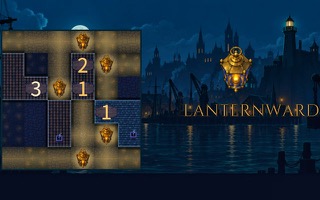
Light every street
Lanternward
Tap a street to place a lantern
Play loads a game hosted by GamePix that may show ads and use cookies.
Provided by GamePix. Ads and cookies may load only after you press Play. Read the GamePix Privacy and Cookie Policy.
Light every open street square with a lantern or a straight line of lantern light.
How to play
How to Play Lanternward
Place lanterns on streets so all open squares receive light, every roof clue is exact, and no two lanterns see each other along an unblocked line.
- 01
Choose the Harbour district and an open level. Read the short rule panel before beginning.
- 02
Inspect every numbered roof. Its number counts lanterns on the immediately adjacent street squares, including only the squares that share an edge with the roof.
- 03
Tap an open street to place a lantern. Its light extends in straight horizontal and vertical lines until a roof stops it.
- 04
Tap a street again to mark a dot when you have proved that a lantern cannot occupy that square. Clear the mark if later reasoning changes it.
- 05
Continue until all streets are lit, all numbered roofs have exactly the required adjacent lanterns, and no two lanterns shine directly at one another.
About the game
A lantern-placement puzzle governed by light, roofs, and exact clues
Lanternward asks you to light every street on a dark city grid. Tapping an open street square places a lantern. Light travels horizontally and vertically in straight lines until a roof blocks it. Two lanterns may not shine directly at each other, and the number printed on a roof tells you how many lanterns must sit directly beside that roof. Those rules work together, so one confident placement can illuminate several streets and restrict several neighboring squares.
The campaign begins in the Harbour district and presents numbered levels with star results and completion times. Inside a puzzle, the board sits beside a timer and buttons for Hint, Mistake, and Reset. A street can also be marked with a dot to record that a lantern cannot go there. Dots are valuable reasoning notes: they let you separate proven exclusions from empty squares you have not decided yet.
Controls
Controls for Lanternward
- Mouse
- Click a street to cycle through lantern, dot, and clear states.
- Touch
- Tap a street to place a lantern, tap again for a dot, and tap again to clear it.
- Puzzle tools
- Use Hint for help, Mistake to check for conflicts, and Reset to restart the current grid.
Useful strategy
Lanternward tips for more reliable runs
- Resolve roofs with very high or very low counts before guessing in open corridors.
- When a roof already has its full lantern count, mark every other adjacent street with a dot.
- When the remaining unmarked neighbors equal a roof’s missing count, those neighbors are forced lanterns.
- Trace each lantern’s row and column to mark squares that would create a forbidden sight line.
- Use roofs as light blockers; two lanterns can share a row only when a roof separates them.
- Do not confuse a lit square with a legal lantern square. Lighting and placement restrictions are separate facts.
- Work from constrained edges toward flexible central streets.
- Use Mistake as a confirmation after a chain of deductions, not as a substitute for reading the clues.
Translate each roof number into local facts
A roof number applies only to the street squares directly beside that roof. Begin by identifying the exact neighbor set; corners that touch diagonally are not part of the clue. Count existing lanterns, confirmed dots, and undecided neighbors separately. This prevents an illuminated street farther away from being mistaken for an adjacent lantern.
Two standard deductions solve much of the grid. If a roof already touches the required number of lanterns, every other adjacent street must be a dot. If a roof still needs two lanterns and exactly two eligible neighbors remain, both are lanterns. Write those deductions onto the board immediately so nearby clues can use them.
Overlapping roof clues create stronger information. A street may sit beside two roofs, so its state affects both numbers. Compare the remaining needs of the roofs before placing anything. When one shared square is the only way both clues can be satisfied, it becomes forced; when using it would overflow either clue, it must be a dot.
Treat every lantern as a line constraint
A placed lantern does two jobs: it lights streets and forbids other lanterns along its clear row and column. Trace outward until a roof interrupts the line, then mark every open square in that visible segment as a dot. This records the no-facing rule and prevents a later local clue from tempting you into a conflict.
Roofs are useful separators. Light does not pass through them, so a lantern on one side does not conflict with a lantern beyond the roof. When evaluating a long row, break it into roof-bounded segments instead of treating the whole line as one corridor. Each segment can usually contain at most one lantern unless other blockers divide it again.
A street can be lit without containing a lantern. This distinction is central. Do not fill every dark-looking place one by one; look for a lantern position that illuminates several squares while respecting clues. After placing one, update both the coverage map and the forbidden-placement map before making the next choice. Then inspect the end of each newly lit corridor. A street that remains dark beyond a roof cannot borrow that lantern’s light, so it still needs a separate source. This quick boundary check keeps one bright region from hiding an unsolved pocket elsewhere on the grid.
Use remaining darkness to find forced positions
After processing the roof clues and sight lines, inspect any street that is still unlit. List the legal squares in its row and column that could illuminate it. If only one candidate remains, that candidate must hold a lantern. This global coverage deduction often resolves areas with no printed number nearby.
When several candidates can light the same street, prefer analysis over guessing. Ask which candidates would also satisfy a roof, which would conflict with another needed lantern, and which would cover additional isolated streets. A candidate that breaks a clue can be dotted. As options disappear, the final legal source of light becomes forced.
Edge streets are useful because they have fewer possible light sources. Clear them early, then propagate the resulting sight-line exclusions inward. Central areas have more options and are easier to solve after outer rows and columns have been constrained by confirmed lanterns and roof counts.
Diagnose a conflict by rule type
If Mistake reports a problem, identify whether it is a roof overflow, a direct lantern sight line, or an unresolved dark street. These failures need different repairs. Removing a lantern from an overflowing roof may fix the count but create darkness elsewhere, so trace all effects before choosing the replacement.
Use dots as proof markers, not guesses. A dot should mean that a lantern there would violate a completed clue, face another lantern, or is otherwise impossible. If too many speculative dots accumulate, clear the uncertain ones and rebuild from confirmed facts. The board is easier to reason about when marks have a consistent meaning.
Reset is useful when the reasoning chain is no longer trustworthy. On the next attempt, begin with the most constrained roof and record exclusions immediately. A cleaner order usually prevents the same contradiction. Hints can reveal a direction, but try to explain why the suggested move is forced so the method transfers to later levels.
Quick answers
Lanternward FAQ
What does a roof number mean?
It is the exact number of lanterns on street squares directly beside that roof.
How far does lantern light travel?
It travels horizontally and vertically until a roof blocks the line.
Can two lanterns face each other?
No. Two lanterns may not share an unobstructed row or column.
What is a dot used for?
A dot records that a lantern cannot be placed on that street square.
Is Lanternward timed?
A timer records the solve, while the opening puzzle still gives you time to reason through each placement.
Game information
Game details
Lanternward is provided through the GamePix-hosted player.
- Distributor and host
- GamePix
More about this game
Keep the break going
Similar games
Read the numbers
Minesweeper Online
Reveal safe squares and use numbered clues to work around hidden mines in a familiar desktop-style puzzle.
Rotate the complete network
Turnline: Relaxing Puzzle
Rotate line tiles, connect the square and circle endpoints, and finish every required branch.