Arrow Escape
Clear a crowded car puzzle by finding open exit lanes and sending each vehicle out in the right order.
- Session
- 2–5 min
- Controls
- Click or tap a car
- Best for
- Logic
Find the clear path
Arrow Escape
Click or tap a car
Play loads a game hosted by GamePix that may show ads and use cookies.
Provided by GamePix. Ads and cookies may load only after you press Play. Read the GamePix Privacy and Cookie Policy.
Press Play to load Arrow Escape, then open a puzzle in the hosted game.
How to play
How to Play Arrow Escape
Clear the parking board by selecting cars whose forward paths are open. Remove useful blockers first, then reread the changed layout before choosing the next vehicle.
- 01
Inspect the cars before tapping. Identify the front of each promising vehicle, then trace a straight line from its front bumper to the boundary of the play area.
- 02
Choose a car whose forward route is unobstructed so it can drive off the board. A short route near an edge is easy to verify, but distance alone does not guarantee that the car faces outward or has a clear lane.
- 03
After the car leaves, scan the row or column it occupied. Its removal may free another vehicle that faces through the same space or expose a route from deeper in the layout.
- 04
When a car is trapped, identify the first vehicle in front of it. Then check whether that blocking car can leave now. Repeat this reasoning until you reach a car with a clear exit.
- 05
Continue selecting open paths until no cars remain. Cars drive only in their facing direction; you do not rotate or drag them. Completing the board shows the level result, and MAIN returns to the level menu where the next unlocked puzzle can be selected.
About the game
A parking puzzle where direction changes everything
Arrow Escape is a portrait parking puzzle built around one clear rule: tap a top-down car and it drives straight in the direction its front is facing. A car can leave the board only when that lane has an open path. Clear every car to finish the puzzle. The challenge comes from finding an order that opens routes instead of choosing a vehicle whose way is still blocked.
Each position carries two kinds of information. The car’s front tells you where it wants to travel, while the vehicles ahead tell you whether that movement is useful now. A car close to the edge may still face inward or have a neighbor in its lane. A car deeper inside the layout may be the correct first move when it faces through a clear corridor.
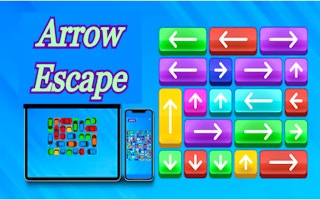
The current GamePix version uses colorful cars as its direction pieces, even though some listing art and descriptions show arrow-marked blocks. Treat the car body and front as the live direction cue. Color helps separate neighboring vehicles visually, but the observed puzzle rule depends on facing and occupied space rather than matching colors.
Controls
Controls for Arrow Escape
- Mouse click
- Select a car and send it straight in the direction its front is facing.
- Tap
- Select a car on a touch screen and let it drive forward along its lane.
Useful strategy
Solve the car order with less guessing
- Trace the entire lane, not just the first small gap. A car needs a clear route from its front to the outside, and a vehicle farther along that line can still block it.
- Start with moves you can prove. Removing one clearly free car gives you a simpler board and better information for the next choice.
- Mark dependency chains mentally: “the center car needs the lower car gone; the lower car needs the corner car gone.” Work back from the final blocker.
- Recheck every route after a departure. Empty space can free cars from several directions, so the best next move may be elsewhere on the board.
- Use the front and length of each car as direction cues. When vehicles sit close together, their outlines help you separate one body from the next and identify the lane that must clear.
- Do not assume every edge car is available. A vehicle that faces inward or sideways through a neighbor can be less useful than a central car facing an open corridor.
How to verify a car’s path
Begin at the front bumper and follow that row or column one space at a time until you reach the outside. If another car occupies the route, the selected vehicle is not your clean exit yet. If the lane is open, it is a strong candidate because its departure will simplify the board without requiring a guess.
The nearest boundary matters only when it lies ahead of the car. A vehicle touching the left edge but facing right must cross the layout toward the right; its left-side position offers no shortcut. Treat “forward” as the direction of the hood, then count obstacles in front rather than judging how close the vehicle looks to any edge.
Turn blocked cars into dependency chains
When your preferred car cannot leave, name its immediate blocker. That turns a crowded parking board into a smaller question: what must move before this one? If the blocker also has an occupied path, look from its front and name the next vehicle. Continue until you find a car with a route to the boundary. Removing that endpoint begins to unwind the chain.
Suppose, as a made-up example rather than a specific level answer, a red car facing right is stopped by a blue car facing up. Blue cannot rise because a yellow car facing left crosses its lane, but yellow has a clear route to the left edge. The useful sequence begins with yellow, then blue, then red. Colors only identify the cars in this example; facing and occupied lanes produce the order.
Some departures help more than one chain. A central car may occupy both the horizontal path of one vehicle and the vertical path of another. If it can leave, removing it creates two candidate moves. You do not need to plan the entire remainder immediately. Compare the newly opened lanes, take another certain exit, and update the chains again.
Read edge cars and central cars correctly
Edge cars are useful scanning anchors because their exit distance can be short. Check outward-facing cars first: a top-row car facing up, for example, has an easy route to verify. Then inspect edge cars facing along the border. They may still need several neighboring vehicles removed before they can drive off the side.
Central cars should not be dismissed as late-puzzle pieces. If a central car faces an empty corridor that reaches the boundary, it can leave immediately and may release several surrounding routes. The true measure of availability is a continuous open lane, not the number of occupied spaces around the vehicle.
Why the board deserves a fresh read after every move
A departed car changes more than its own location. It can open a complete lane or turn the endpoint of a dependency chain into a free vehicle. Continuing with a plan formed two moves ago can overlook a safer new exit. Treat every successful departure as a new puzzle state.
Use a compact reset after each tap: inspect the cleared lane, check cars facing through it, then scan the outer edges for newly available vehicles. This takes only a moment and keeps the reasoning tied to the current layout. If two options are open, prefer the one that removes a blocker for another known car or creates space through the center.
A stalled position is a signal to rebuild the chains, not to tap randomly. Choose one remaining car, trace forward to the first obstacle, and repeat until you locate a removable endpoint. If the chain loops through several nearby vehicles, inspect a different direction from the edge. The goal is always the same: find a path you can verify from front bumper to boundary.
Quick answers
Arrow Escape FAQ
What is the goal in Arrow Escape?
Remove every car from the parking board. Each selected vehicle drives straight in the direction it faces, so you need an order that opens the required lanes.
How do you know which car to tap first?
Look for a car with a clear, straight route from its front bumper to the outside. Outward-facing edge cars are quick to check, but a central car can also be available when its full lane is empty.
Does a car always leave when it is close to an edge?
No. It must face along an open route toward the boundary. A car can sit at one edge while facing inward through several other vehicles.
What should you do when the car you want is blocked?
Look ahead to the first blocking vehicle, then inspect that car’s own forward path. Continue until you find a clear endpoint, remove it, and work back through the chain.
Why should you rescan after every move?
One departure can open several routes at once. A fresh scan catches those new options and prevents you from following a plan based on spaces that are no longer occupied.
Can Arrow Escape be played with a mouse or touch input?
Yes. Click a car with a mouse on desktop or tap it on a touch device. The car then drives straight in the direction its front is facing.
What happens after you clear every car?
The game displays the completed level. Choose MAIN to return to the level menu, then select the next puzzle after it unlocks. Later observed layouts contain more cars, so repeat the same lane and dependency checks on the denser board.
Game information
Game details
Arrow Escape is distributed here under a GamePix license through the GamePix-hosted player. This guide describes the current car-based puzzle presentation observed in that player.
- Distributor and host
- GamePix