Math Crosswords
Choose numbers from the bank and fill a grid of intersecting arithmetic equations.
- Session
- At-your-pace puzzles
- Controls
- Select a number, then click or tap an empty cell
- Best for
- Logic
Landscape gives you more room
Solve crossing equations
Math Crosswords
Select a number, then click or tap an empty cell
Play loads a game hosted by Playgama that may show ads and use cookies.
Provided by Playgama. Ads and cookies may load only after you press Play. Read the Playgama Privacy and Cookie Policy.
Read a row or column with one empty square.
How to play
How to Play Math Crosswords
Choose a number from the bank and place it in an empty equation cell.
- 01
Wait for the level grid and number bank to finish loading.
- 02
Read a row or column that has only one empty square and calculate the missing number.
- 03
Select the matching number in the bank, then select the empty cell; dragging from the bank is another desktop input described by the game.
- 04
Recheck any equation crossing that cell before moving to another blank.
About the game
Math Crosswords
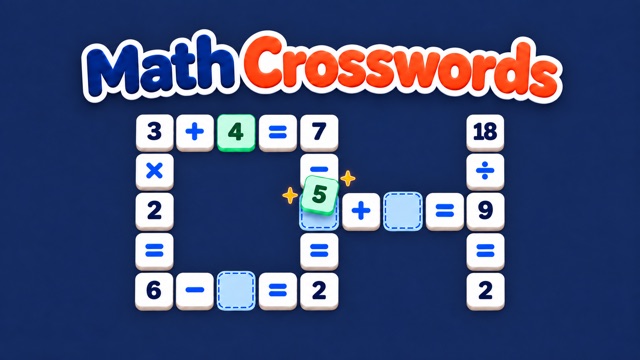
Math Crosswords combines a number bank with a grid of short equations. Some numbers are printed on the board, while empty squares must be filled from the available choices. The important difference from a word crossword is that every horizontal and vertical line has arithmetic meaning. A number that seems to complete one expression may also be part of another, so read both directions before committing it.
The first board makes that idea visible without requiring advanced math. Its vertical equation starts with 1, has a blank, and ends at 10; the horizontal equation begins with two blanks and also ends at 10. The bank offers 1 and 9. Work out that the vertical blank needs 9, then use the crossing row to see where 1 belongs. A completed board shows 1 + 9 = 10 vertically and 9 + 1 = 10 across.
This is a good game for a short, deliberate session. You do not need to race through the bank. Read a complete equation, work out the missing value, place it, and then inspect the new grid. Later arrangements may be larger than the opening example, so the method matters more than memorizing the first answer.
Controls
Controls for Math Crosswords
- Click or tap a number, then an empty cell
- Place that number in the grid.
- Drag a number to an empty cell on desktop
- Use the alternate placement method.
- Click or tap a filled cell
- Return its number to the bank when you need to revise it.
Useful strategy
Solve the crossing, not just the square
- Start with an equation that has exactly one unknown; it gives a definite candidate.
- Check the other direction when a blank lies where a row and column cross.
- Use the remaining number bank as a constraint, not as a list to place in order.
- Keep the light-bulb hint for a genuine impasse; the opening grid can be reasoned through directly.
Read every crossing in both directions
Begin with the symbols rather than the empty boxes. A plus sign tells you that the two nearby numbers combine into the displayed total; an equals sign identifies the result. On the first screen, the vertical 1 + blank = 10 gives you 9. That value also fills the left blank in the horizontal blank + blank = 10, leaving 1 for the right blank. Work from the equations instead of guessing from the bank.
A crossing cell deserves a second look because it can satisfy one line and spoil another. If a row suggests one value but a column suggests something else, check which square belongs to which expression before entering anything. Follow the visible borders and printed operators; do not assume a number belongs to a nearby line simply because it is visually close. In larger grids, this habit prevents several corrections later.
You can also work backward from a result. If the total and one addend are already printed, subtract the printed addend from the total to find what the blank must contain. The same idea applies when the unknown is in a different position: translate the whole visible expression into a simple calculation, then check the bank for the calculated value. The bank confirms availability; the equation explains why the value belongs there.
Make a first placement you can verify
Level 1 offers 1 and 9 in its number bank. The vertical equation reveals where 9 belongs, and the remaining horizontal gap takes 1. Select a bank tile and then its intended dashed square. Once the guided placement is complete, the board can show 9 + 1 = 10 across and 1 + 9 = 10 down, with the number bank empty. Read the filled equations to confirm the result.
Use the same two-step rhythm on later blanks. First choose a number for a reason, then place it in the specific cell that needs it. Pause long enough to confirm the cell changed before selecting another number. If you click quickly across several squares, you may lose track of which bank tile was selected and which equation now needs a second check. A short pause keeps the puzzle readable.
The game also describes dragging a bank tile into a blank on desktop. Click-then-cell is an easy alternative, especially on touch screens where dragging a small square across a narrow view can be awkward. Either way, look for a number visibly entering the intended cell. If the board still shows a blank, check whether you selected a bank tile and then an actual empty square.
Treat the bank as a constraint
Numbers in the bank are available pieces, not a suggested order. Resist the urge to place the first tile you notice. A puzzle can offer several plausible looking values while only one balances a particular equation. Read a line, calculate its missing value, and then find that value in the bank. That ordering keeps the arithmetic in charge of the move.
After a successful placement, look at the bank again. A used tile is no longer among the choices; the completed first board leaves no bank tiles. This makes the remaining choices informative on larger puzzles. If another line appears to need a value you already used, revisit the crossings before assuming the game will supply another copy. You may have placed the right number in the wrong location.
When a grid has several blanks, solve the most constrained line first: one empty cell and enough printed values to calculate it. Then use the reduced bank and the newly filled crossing to narrow the next line. This method creates a chain of justified placements. Filling easy-looking cells at random may temporarily make the board look complete without making the equations correct.
Correct a placement without restarting
A wrong answer is a local problem, not a reason to abandon the board. The game instructions say that tapping a filled cell returns its number to the bank. Use that before trying a different value. Check the full expression that failed, then check a crossing expression to decide whether the cell itself is wrong or whether the other unknown was filled incorrectly.
Completed equations can show correctness feedback, with green for correct and red for wrong according to the official game instructions. Do not rely only on a color if the screen is small or an animation is still running. Read the numbers and operators as well. If 9 + 1 visibly equals 10, you can explain why the line is right; if a line is red, recompute it instead of shuffling bank tiles until the color changes.
A correction is most useful when you can name the mistake. Perhaps you treated a crossing as part of only one row, misread the total, or chose a number before checking the second direction. Fix that cause, return the misplaced tile, and make one new placement. Repeating the same rapid guess with a different bank tile teaches little about the grid.
Use hints and time deliberately
A light-bulb control appears on the game screen, with a small count beside it. The game describes a hint as placing one correct number automatically. Treat the displayed count as limited help on the current screen, not a promise that hints are free, unlimited, or restored on every future level. Try the vertical equation and its crossing before using one.
Before using a hint, inspect any line with one blank, then inspect the cells where two incomplete lines cross. Write down the arithmetic mentally: known value, operator, missing value, result. If the same blank belongs to two lines, compare both calculated values. This usually produces more information than looking at the bank alone. A hint is most valuable after you have genuinely run out of deductions.
The game page describes better scoring for quick, hint-free solving. That is a reason to learn a steady method, not to rush the first level. Start by making correct placements and understanding feedback. Once you can read the grid confidently, faster scanning may follow naturally. A score is useful only after the equations are right, so prioritize a sound solution over a rapid series of guesses.
A practical routine for your first session
Open the player and wait until the whole board is visible. In Level 1, start with the vertical 1 + blank = 10, so that crossing blank must be 9. The horizontal row then becomes 9 + blank = 10, making its last blank 1. Choose a bank number, place it in the matching dashed cell, and read both completed equations before moving on.
As the board grows, move from a known equation to a crossing, then to the next known equation. If the chain stops, check whether any row or column now has only one gap. If you made an uncertain placement, return that tile and reason through both directions again. This keeps each move reversible and understandable.
When you want a different logic task afterward, the related games below include a word crossword and a number-path puzzle. Their controls and win conditions differ from Math Crosswords. Carry over the habit of reading the current objective, but let each game explain its own rules. Here, a good first session ends with a series of justified placements rather than a lucky bank-order guess.
Quick answers
Math Crosswords FAQ
How do I enter a number?
Select a tile in the bank and then select an empty square. In the opening level, choosing 1 and the blank completed 9 + 1 = 10.
What if I enter the wrong number?
Select the filled cell to return that number to the bank, then check the row and any crossing column before trying another tile.
Do I need the hint for Level 1?
No. The vertical 1 + blank = 10 gives you 9, and the crossing row then gives you 1. Save the light-bulb control for a board where checking both directions leaves you stuck.
Game information
Game details
Math Crosswords runs in the official Playgama player, which may use cookies or show advertising.
- Developer
- Nas Games
- Distributor and host
- Playgama
More about this game
Keep the break going
Similar games

Fill the cozy crossword
Busha's Crossword
Select a square, read its across or down clue, and type a short answer into the connected grid.
Count every bridge
Number Bridge Puzzle
Connect numbered islands with one or two bridges, satisfy each count, and link the whole network.