ChillPaths
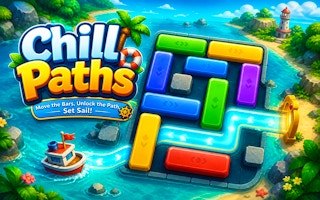
Slide frozen blocks out of the way and open a route for a little boat.
- Session
- 3–10 min
- Controls
- Drag blocks with the mouse or a finger
- Best for
- Relax
ChillPaths
ChillPaths
Drag blocks with the mouse or a finger
Play loads a game hosted by GamePix that may show ads and use cookies.
Provided by GamePix. Ads and cookies may load only after you press Play. Read the GamePix Privacy and Cookie Policy.
Look for the route the boat needs to reach the exit.
How to play
How to Play ChillPaths
Inspect the boat's intended route, slide the frozen bars that block it, and preserve enough empty grid space to complete the whole clearing sequence.
- 01
Locate the boat and its apparent destination. Trace the shortest visible corridor between them and list every frozen bar currently crossing or occupying that space.
- 02
Select the first direct blocker and test where it could move. If no useful space is available, identify the neighboring bar that must move first to create room.
- 03
Drag or swipe a movable frozen bar along its length through open grid space. Release it at a position that improves the route without occupying a cell needed by another planned move.
- 04
Recheck the whole corridor after each slide. A moved bar may reveal a new dependency, create a useful pocket of space, or block a route that looked open from the previous position.
- 05
Keep a short sequence in mind: space-making move, blocker move, then path-opening move. If the sequence fails, return attention to the first position where the required space disappeared.
- 06
Once the route is clear, drag the boat through the exit to complete the level. Use the displayed move count and star result as feedback on the finished solution.
About the game
Slide frozen bars until the boat has a clear route
ChillPaths is an icy sliding-block puzzle with a small boat waiting for a usable path. Frozen bars occupy the grid, and the objective is to move them along their length in an order that clears the route, then drag the boat through the exit. The challenge is understanding which block is directly in the way, which other block prevents that blocker from moving, and where enough empty space can be created.
A move can help locally while making the full puzzle harder. Sliding one bar away from the boat may occupy the only space another bar needs. Strong solutions therefore begin with the intended route and work backward through the obstacles. Before moving anything, identify the cells the boat appears to need and the bars crossing that corridor.
Each level rewards position, sequence, and careful use of ordinary block movement. Read the current board for the direction and distance available to each frozen bar, then make the smallest slide that creates the space your route needs.
Controls
Controls for ChillPaths
- Mouse drag
- Slide a movable frozen bar through available grid space.
- Touch drag or swipe
- Move a frozen bar on a touch device.
- Drag the boat
- Move the boat through the open exit after clearing its route.
Useful strategy
Solve the order of movement before chasing open space
- Start from the boat's route, not from the easiest block to move. An easy slide is useful only when it removes or unlocks a real obstacle.
- Treat empty grid cells as a working resource. Moving a bar into a large open area may remove the maneuvering room needed for the final blocker.
- Separate direct blockers from dependency blockers. The bar across the path may be the final move, while a bar several cells away controls whether that final move is possible.
- Plan two or three slides ahead, then reassess. A complete solution may be hard to visualize at once, but a short planned sequence prevents random movement.
- Avoid filling narrow pockets unless that position is clearly part of the solution. A bar parked in a confined area may have fewer useful exits later.
- When stuck, rebuild the dependency chain from the goal: what must leave the route, what space does it need, and what currently occupies that space?
Trace the boat's route before moving the first bar
Begin by marking the cells between the boat and its destination. Some layouts may present a visually obvious channel, while others require you to compare more than one possible corridor. Focus on what the current board shows and choose the route with the fewest hard obstructions, not merely the route that looks shortest in a straight line.
Classify each obstruction. A direct blocker occupies the intended corridor. A support blocker sits outside the corridor but prevents a direct blocker from sliding away. This distinction stops you from repeatedly pushing the most visible obstacle when the necessary move must begin elsewhere.
Once you have a candidate route, name the likely final clearing move. Then ask what position that bar must reach and whether that destination is currently free. Working backward from the final move gives the opening slide a concrete purpose.
Build a dependency chain from the final blocker
Suppose a bar across the route needs to slide into an adjacent opening, but another frozen bar occupies part of that opening. The second bar becomes the first dependency. If it also lacks room, continue tracing backward until you find a bar with a genuinely available destination. That bar is the practical starting point.
Keep the chain short enough to remember: move A to free space for B, move B to free space for C, then move C out of the boat's route. After completing A, verify that its new position does not block B in a different way. The board state is the authority, even when the imagined sequence looked clean.
Dependencies can change when a large space opens. A bar that originally needed two preparatory moves may gain another route after only one. Recalculate rather than completing an outdated sequence automatically. Efficient play comes from preserving the goal while adapting the intermediate order.
Protect the maneuvering space around important blocks
Empty space is what allows the bars to change position. A broad opening near the center can serve several different blocks, while a corner pocket may help only one. Before parking a bar, ask how many later moves depend on the destination cells. Prefer positions that leave shared working areas available.
A move that creates one empty cell but consumes three useful cells may be a poor exchange. Compare the shape of the space as well as its size. Long bars need a compatible opening, and a scattered set of small gaps may not help the blocker you need to relocate.
Do not clear the boat's immediate front at the cost of sealing the next section of its route. Trace the whole intended corridor after each major move. The solution needs continuous usable space, not a single impressive gap beside the starting position.
Plan short move sequences and verify each link
Trying to predict the entire puzzle can overload attention, especially when many bars overlap the likely route. Plan the next two or three meaningful movements instead. The first should create space, the second should use that space, and the third should visibly improve the boat corridor or unlock its next blocker.
After each slide, check three things: whether the intended destination was reached, whether the next bar still has room, and whether the boat's route is more open. If one answer is no, pause before adding more movement. Early correction is easier than untangling several purposeless slides.
Use stable landmarks on the grid to remember positions. Rather than thinking that a bar moved vaguely left, note that it now sits beside the boat, against an edge, or beyond a particular crossing. Concrete position memory makes it easier to recognize the first move in a failed branch.
Avoid common positional dead ends
Moving a bar as far as possible can feel decisive, but the farthest position is useful only if the bar can still participate in the solution. Stop at the position that frees the required cells. Extra distance may occupy another corridor or reduce the bar's ability to move back when the board needs a different order.
Be cautious with narrow edges and corners. A bar placed there may be harmless when it is truly finished, but harmful when another block later needs the same edge space. Decide whether you are storing the bar temporarily or placing it in its likely final position; temporary storage should retain an escape route.
Randomly cycling several bars can return the board to a familiar shape without revealing why it fails. If you notice a loop, stop and identify the unchanged dependency. Choose a move that changes access to the needed space rather than repeating a visually different version of the same blockage.
Recover by finding the first broken assumption
When the boat route remains closed, return to the final blocker and retrace the dependency chain. The mistake is often an assumed parking space that another bar now occupies. Locate the first planned move that is no longer possible; later moves depend on it and do not need separate analysis yet.
If the board allows you to restore earlier positions through ordinary sliding, reverse only the moves needed to recover the shared space. Do not scatter every bar. A controlled rollback preserves the parts of the route that were genuinely improved and gives you a clear alternative branch.
If the initial route proves too constrained, compare another corridor visible on the level. The alternative may require moving more direct blockers but offer much better maneuvering room. Count dependencies, not just obstacles: three movable blockers can be easier than one blocker trapped behind a long chain.
Quick answers
ChillPaths FAQ
What is the goal in ChillPaths?
Slide the frozen bars in an order that creates a usable route for the little boat to reach its destination.
How do I move the frozen bars?
Drag or swipe a movable bar through available grid space. Use the response of the current board to see which direction and distance are legal.
Which block should I move first?
Start from the bar directly blocking the boat's route, determine what space it needs, and then move the earliest dependency that can actually reach an open position.
Why can an open-looking move make the puzzle harder?
A moved bar can occupy maneuvering space needed by another blocker. Check the next planned move and the full boat corridor before choosing a parking position.
What if a frozen bar will not move in the direction I want?
Check whether another bar occupies the needed grid space. Follow the movement the board permits and clear the dependency before returning to the direct blocker.
Should I move a bar as far as it can go?
Only when the far position supports the route. Often the better move is the shortest slide that frees the required cells while preserving space for another bar.
What should I do when I keep repeating the same moves?
Stop the loop and trace backward from the final blocker. Find the first required space that never becomes available, then change the move that controls that space.
Game information
Game details
ChillPaths is provided through the GamePix-hosted player. The external player may display advertising and is governed by GamePix's privacy terms.
- Developer
- brad-gupta111
- Distributor and host
- GamePix
More about this game
Keep the break going