Traffic Memory
Flip vehicle cards and use remembered locations to find matching pairs.
- Session
- Flexible short sessions
- Controls
- Click or tap two cards
- Best for
- Casual
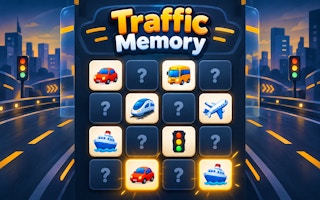
Remember the vehicle positions
Traffic Memory
Click or tap two cards
Play loads a game hosted by GamePix that may show ads and use cookies.
Provided by GamePix. Ads and cookies may load only after you press Play. Read the GamePix Privacy and Cookie Policy.
Choose a board size and press Play.
How to play
How to Play Traffic Memory
Choose a board size, reveal two cards, and use remembered positions to complete matching vehicle pairs.
- 01
Select Easy, Medium, or Hard before pressing Play. Start with the smallest board when you want a manageable practice round.
- 02
Click or tap one question-mark card to reveal its picture. Remember both the symbol and its row and column.
- 03
Choose a second card. If the pictures differ, let the mismatch turn over and retain the two locations in memory.
- 04
When you reveal a vehicle whose partner you already know, choose that remembered location as the second card.
- 05
Continue through the board using a consistent scan order. Use pause when interrupted, and inspect the remaining Hint count before choosing help.
About the game
Traffic Memory
Traffic Memory is a card-pair game built around vehicles and travel symbols. Turn over two cards and look for identical pictures. A successful pair remains visible with a highlighted border, while a mismatch turns back over. Your main task is to remember where a picture appeared, then return to that position when its partner is revealed.
The title screen offers a four-by-four Easy board, a six-by-six Medium board, and an eight-by-eight Hard board. Begin with Easy if you want to learn the input or practice a consistent search order. Sixteen cards give you eight pairs to locate. Increasing the board size adds more locations to remember; it does not make random guessing a better strategy.
The game screen shows a timer, score, attempt counter, and coins, with pause, sound, and a limited Hint control. In an opening Easy game, flipping a tram and scooter produces a mismatch and increases the attempt counter. Later, returning to the two remembered tram positions creates a highlighted pair and changes the score from zero to fifty. Focus on those visible results rather than assuming a particular reward formula for every difficulty.
Controls
Controls for Traffic Memory
- Click or tap a card
- Reveal a card and choose the second card of a pair.
- Pause button
- Open the game’s pause control when you need a break.
- Hint button
- Request the available in-game help; read the remaining count.
- Sound button
- Toggle the game audio.
Useful strategy
Make your next move count
- Give every location a short name, such as top-left tram or row two scooter. A picture without a location is difficult to use.
- Search one row at a time until you reveal a known partner. Finish that pair, then return to your search order.
- After a mismatch, rehearse both positions before choosing another card. The failed attempt still provides useful information.
- Keep similar symbols distinct. A scooter, motorcycle, and bicycle can occupy the same mental category while being different pairs.
- Choose a known match instead of using the second flip to explore another unknown card. Clearing a pair reduces the remaining memory task.
- Practice on Easy before enlarging the board. Increase difficulty when you can retain positions, not simply when you can click faster.
Build a small map in your head
The most useful memory combines a picture with a position. Instead of remembering only “tram,” remember “tram at the top-left.” When another tram appears, the location gives you an action. On a four-by-four board, simple row and column names are enough. You do not need to memorize pixel coordinates or the exact shape of the card.
Use a stable orientation. Treat the top row as row one and the left column as column one throughout the round. If you rotate your own mental view halfway through, a remembered card can seem to have moved. The board gives you clear rows and columns, so use them as landmarks rather than relying on a vague impression that a symbol was somewhere near the middle.
After turning two different cards, name both locations before continuing. For example, top-left tram and top-row second scooter. Then move to the next unexplored part of your scan. This turns a mismatch into information. Forgetting both cards and immediately guessing elsewhere spends an attempt without improving the plan.
Separate exploration from collecting known pairs
At the beginning, most cards are unknown, so exploration is unavoidable. Choose the first card in a consistent order, such as moving left to right across a row. If you have not seen its partner, reveal another unknown card and remember both results. If you have seen the partner, use the second flip to take the known pair.
This distinction matters because the second flip has a purpose. You can either learn a new location or finish a pair you already understand. When a match is known, collecting it usually makes the remaining board easier to remember. Leaving several known pairs unfinished adds unnecessary choices to later turns.
After a completed pair, return to your scan position rather than restarting the search from the first card. The highlighted matched cards act as landmarks and show which locations no longer need attention. A clean search pattern is especially useful on larger boards, where repeatedly revisiting uncertain cards can make the round feel more confusing than it is.
Use picture details to separate similar vehicles
The theme includes different kinds of transport and traffic symbols. Similar shapes can cause a false memory: a scooter is not a motorcycle, and a tram is not a van. Choose one distinctive feature when you first see a picture. A tram’s overhead connection, a scooter’s narrow standing deck, or a traffic light’s colored lamps can make the label more specific.
Do not create a complicated story for every card. The detail only needs to distinguish it from the other pictures currently in the round. If your labels become long and elaborate, remembering them can become another task. A short symbol name plus a location is usually enough for an Easy board.
When a supposed match fails, inspect the two pictures instead of assuming the click missed. You may have confused similar transport icons or remembered the wrong column. Correct the label immediately while both cards are visible. Repeating the same mistaken association later wastes more attempts than taking a moment to repair it now.
Choose a board size that supports the kind of practice you want
Easy presents four rows and four columns, so you can survey the board and assign locations quickly. It is a good place to learn the mismatch delay, the appearance of a completed pair, and your preferred search order. A successful small round can teach more than a large round dominated by guesses.
Medium and Hard expand the number of positions. Before increasing size, ask whether you can reliably return to a card revealed several turns earlier. If not, keep practicing the smaller layout with more precise location labels. The aim is to improve recall, not simply to create a longer session.
On a larger board, divide the layout into recognizable areas while retaining row and column references. You might search the upper rows first, then the lower rows. Keep that order stable and collect known matches when they appear. Changing the search route every turn makes it harder to tell which cards remain genuinely unexplored.
Read the timer and help controls without letting them disrupt recall
The timer records elapsed play, and the attempt indicator changes after selecting two cards. These are useful feedback, but rushing to protect the timer can undermine the memory work. A brief pause to encode two locations may prevent several later mismatches. Compare the clarity of your decisions before trying to optimize speed.
The first successful tram pair in the opening Easy round produced fifty points. That confirms that pairing changes the score, but it does not establish every scoring bonus, coin reward, or end-of-round calculation. Read the result presented by your own game. A fast series of clicks is not necessarily better if it increases uncertainty about where the cards are.
The board initially offers three hints. Treat help as limited and read what the current control offers before using it. If you are practicing unaided recall, save it for a moment when your map has become confused. The title screen also contains shop, daily reward, goals, and awards controls; none is required to start a basic pair-matching round.
Recover from a forgotten location
If you cannot remember a partner’s exact position, narrow the uncertainty honestly. Was it in the first row or the second? Was it left or right of a completed pair? Use the landmarks you do remember rather than pretending you know the answer and clicking rapidly.
After another mismatch, update your map and return to the scan order. Do not reopen a known card repeatedly while hoping its partner will become obvious. The round becomes simpler as pairs are completed, and careful recall improves your next decision even when the previous attempt was wrong.
Quick answers
Traffic Memory FAQ
How do I know a pair succeeded?
The two identical pictures remain face up with highlighted borders. The opening tram pair also increased the score.
What happens after a mismatch?
The different cards turn back over. Remember their positions before choosing another pair.
Which size should I start with?
Easy uses a four-by-four board and is a manageable place to practice location labels and a consistent search order.
Do I need the shop or daily reward?
You can begin a basic round with the board-size selector and Play. Those extra title-screen controls are separate from finding pairs.
Game information
Game details
Play through the official GamePix publisher player. The external game may use cookies or display advertising under GamePix terms.
- Distributor and host
- GamePix
More about this game
Keep the break going