Snowboard Knockout: Race Game
Guide a snowboarder downhill with A and D or arrow keys while tracking course progress.
- Session
- Short racing runs
- Controls
- A and D or left/right arrows to steer
- Best for
- Skill
Landscape gives you more room
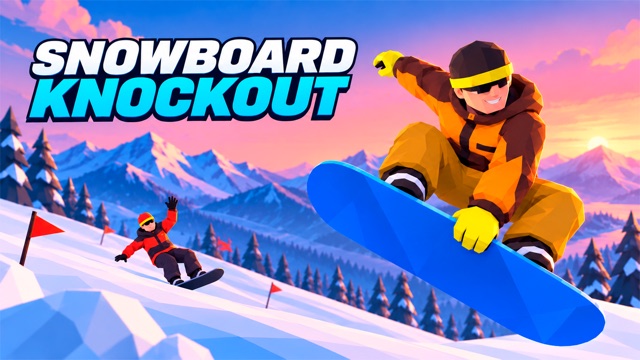
Steer between the gates
Snowboard Knockout: Race Game
A and D or left/right arrows to steer
Play loads a game hosted by Playgama that may show ads and use cookies.
Provided by Playgama. Ads and cookies may load only after you press Play. Read the Playgama Privacy and Cookie Policy.
Steer while the rider descends.
How to play
How to Play Snowboard Knockout: Race Game
Steer the rider downhill and aim through each visible gate.
- 01
Wait for the course and rider to appear; the opening run begins immediately.
- 02
Read the steering prompt and use A or D to move the rider horizontally.
- 03
Look ahead for the next gate flags and line the rider up between them.
- 04
Use the track percentage and current prompt to judge the run’s progress.
About the game
Snowboard Knockout: Race Game
Snowboard Knockout: Race Game puts a rider on a downhill course that starts moving quickly. The first visible instruction says to steer with A and D. Soon afterward it asks you to ride the gates. A percentage readout tracks progress along the course, so you have a simple way to see that the run continues while you learn the controls. The task is to keep the rider aligned with the course rather than treating the screen as a static menu.
The opening display starts around 2% track progress. Hold D briefly and the rider shifts right as the course continues toward 8%; the prompt then changes from steering to riding the gates. Use this opening stretch to learn how much a short steering input moves the rider. The finish and later obstacles should be judged from the live course as they appear.
Begin with small steering corrections. Look ahead to the next pair of gate flags, then move toward the space between them before the rider reaches the markers. Because the scenery comes toward you, a late correction can be harder to judge than an early one. Watch where the rider is relative to the gate, release the key after the adjustment, and prepare for the next opening. That pattern is more useful than holding one direction for the entire hill.
Controls
Controls for Snowboard Knockout: Race Game
- A and D
- Steer left and right as shown in the opening tutorial.
- Left and right arrow keys
- Alternative steering keys listed by the game.
Useful strategy
Steer before the gate reaches you
- Look at the opening between flags, not just at the rider.
- Use short corrections and release the steering key once aligned.
- Check the track percentage after an input to see that the run is advancing.
- If the rider veers too far, counter-steer gently rather than holding the opposite direction for a long time.
Read the opening while the hill moves
The course is active from the opening. There was no need to search for a separate race menu before making the first steering input. A prompt on the screen said to steer with A and D, and a track percentage showed early progress. Read both as part of the race: the prompt tells you what input to learn, while the percentage confirms that the rider is advancing down the hill.
Do not wait for a long tutorial pause. The background and rider can move while you are reading. Make one modest correction, then see how far it moves the rider on the screen. D shifts the rider right. Use that response to judge the current turn; future turns may have different width or timing.
The percentage is a progress cue, not a score or a guarantee of success. It can rise from roughly 2% to 8% over the opening stretch. A higher number tells you that more of the course has passed. It does not by itself prove that you passed every gate correctly. Keep the visible path and the next instruction in view as well.
Aim through the gate rather than at a flag
After the steering prompt, the game told us to ride the gates. The useful target is the open space between the gate markers. A player who watches only one flag may steer directly into it. Instead, notice the left and right boundaries and imagine the center line that passes between them. Shift the rider toward that line before the flags arrive at the rider’s position.
A downhill view can make distances feel shorter as objects approach. Look a little farther up the course than the rider’s feet. If the gate opening is on one side, begin moving early enough to allow a small correction later. A single long steering hold can carry the rider past the center, which is why short taps or brief holds are easier to learn from.
Do not assume a missed gate ends the run or has no effect; watch the player for its actual response. For the opening, a safer goal is to learn the geometry: find the pair, center the rider, and see what happens when it passes.
Measure a steering input before holding it
A brief D hold shifts the rider clearly to the right. Treat that as a strong input. Use it as a reason to test brief holds first rather than pressing a key for several seconds. A quick rightward movement can be helpful for a right-side gate, but excessive movement can leave the rider near the course edge when the next gate appears.
A practical test is to press one direction briefly, release it, and compare the rider with the center of the track. If you overshot, correct with the other direction in a smaller dose. This two-step adjustment gives you useful feedback even without knowing the game’s exact steering sensitivity. Your window size and player scale can also affect how large the movement looks on screen.
The game lists arrows as an alternative to A and D. Pick one control pair for the run so your hands can learn the response. If the first key appears ineffective, click inside the player to focus the frame and confirm that the course is active. Do not assume that repeated frantic key presses will resolve a focus problem.
Prepare for the next opening
Passing one visible marker is not the end of a downhill run. As the scenery advances, look ahead for the next pair. A gate can require movement in the opposite direction from the previous one, so staying at the far side of the course may create a difficult late correction. Return your attention to the new opening as soon as the old one is behind the rider.
Think in short segments. The first segment is learning the steering key, the next is aligning with one gate, and the following segment is recovering a useful position for another gate. This is a planning method, not a claim about a fixed sequence of level layouts. The game can present different scenery or later instructions farther down the hill.
Use the progress display as a secondary check. If the percentage is increasing, the run is still moving forward. If you see a new prompt, read it before assuming the old steering lesson covers everything. The opening teaches steering and gates; read any later instructions when they appear.
Recover from common first-run mistakes
If you drift too far to one side, release the key and make a smaller correction back toward the next opening. Holding the opposite direction for too long can replace one overshoot with another. The aim is not to remain at the exact center of the screen at all times; it is to be centered between the relevant flags when you reach them.
If the rider seems to ignore the keyboard, check whether the browser focus is inside the game frame. Click the player once, then try a short A or D input. If the course is paused or still loading, wait for visible movement and the track indicator before testing again. Wait for the rider and course to move before testing steering.
If a gate slips by, continue reading the next part of the run rather than inventing a penalty from a single moment. Read the game’s own response to a missed gate instead of assuming a scoring rule. The valuable lesson is whether your steering began early enough. On another attempt, choose a slightly earlier, shorter correction and compare the alignment.
A steady first-run routine
For the opening run, look at the current instruction, locate the rider, then locate the next gate opening. Press one steering direction only long enough to bring the rider closer to that opening. Release, observe, and correct if needed. This rhythm turns a continuous downhill scene into manageable decisions you can evaluate one at a time.
A brief D hold can move the rider right while the opening progress rises from about 2% toward 8%. That does not mean right is always the best first move. Your best direction depends on the gate visible in your own run.
If you want another fast steering challenge, the related games below offer different courses and movement rules. Learn those rules separately. In Snowboard Knockout, begin by solving the first visible problem: steer between the gate flags while keeping enough room to adjust for the next pair. A controlled correction is more useful than a long, blind hold.
Quick answers
Snowboard Knockout: Race Game FAQ
Which keys steer the snowboarder?
The opening prompt shows A and D. The game also lists left and right arrow keys as steering controls.
What does the track percentage mean?
It shows progress along the course, starting around 2%. It is not a finish position or a gate score.
How should I approach a gate?
Look between the two markers, steer toward the opening early, release the key once aligned, and prepare for the next pair.
Game information
Game details
Snowboard Knockout: Race Game runs in Playgama’s official player, which may use cookies or show advertising.
- Developer
- Whitebrix Interactive
- Distributor and host
- Playgama
More about this game
Keep the break going
Similar games
Hold the racing line
Slope Racing 3D
Steer a speeding ball down an endless slope, dodge gaps and barriers, and chase a longer run.
Steal and carry loot home
Collect Brainrots on a Skateboard Online
Ride from your base to the arena, steal a collectible, then follow the route back.