Merge Beasts
Move equal-number beast cards together and watch the board create higher values.
- Session
- Flexible short sessions
- Controls
- Drag one beast card onto a matching-number card
- Best for
- Merge
Landscape gives you more room
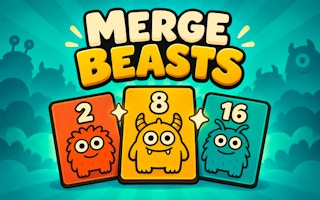
Combine matching beast cards
Merge Beasts
Drag one beast card onto a matching-number card
Play loads a game hosted by GamePix that may show ads and use cookies.
Provided by GamePix. Ads and cookies may load only after you press Play. Read the GamePix Privacy and Cookie Policy.
Read the numbers before moving a card.
How to play
How to Play Merge Beasts
Find equal values across the four stacks, combine them, and preserve room for the next move.
- 01
Read the exposed cards in the four stacks and find two with the same number.
- 02
Drag a card to the stack holding its matching-number partner and release.
- 03
Check that the pair became a higher-value card and the stacks settled.
- 04
Re-scan exposed values and stack heights before choosing another move.
About the game
Merge Beasts
Merge Beasts presents four stacks of creature cards marked with numbers such as 2, 4, 8, and 16. Read the number on each card instead of relying only on its creature illustration. Drag a card to another stack; equal values can combine into a higher value. In the opening arrangement, moving one 8 onto another produces a 16 and the star counter rises from zero to one. That is a clear first example of the matching rule and its visible reward feedback.
Each stack can hold up to seven cards, so a stack's remaining capacity matters from the start. Scan the values at the movable ends of the stacks, then consider where the moved card and any merged result will sit. A matching pair is useful only if the move is allowed and leaves the next card you need accessible. Watch the height of every stack before placing an unmatched card on it; filling a column may leave fewer choices for the next move.
Use each merge as a chance to reconsider, not as an invitation to drag the next visible pair at once. Wait for the result card and star counter to settle. Then inspect which numbers remain, which cards are exposed, and which stacks are close to their seven-card limit. The first successful 8 plus 8 merge proves the basic mechanic; it does not establish a fixed end value or a universal scoring formula. Let the current stack arrangement, not an assumed target number, guide the next decision.
Controls
Controls for Merge Beasts
- Drag a numbered beast card
- Move it to another stack with an equal-value card to attempt a merge.
- Read the stacks after release
- Use the result number and any updated star feedback to verify the action.
Useful strategy
Keep the next stack move available
- Read the printed numbers instead of relying on similar creature art.
- Look one merge ahead: which stack receives the result, and what card will be exposed next?
- Track the seven-card limit and keep room in more than one stack for later moves.
- Check the star counter as feedback, but use the card values to plan.
- If a drag produces no higher card, check the exposed values and whether the receiving stack has room.
Read values before moving
The creature drawings make the four stacks lively, but the numbers define a merge. A monster with an 8 and another card with an 8 are a useful pair even if their images look different. Conversely, two similar creatures should not be treated as a pair until their values agree. Start each turn by reading the exposed cards and finding an equal value in another stack that you can move toward.
In the opening arrangement, 2, 4, 8, and 16 appear together. That mix gives you several levels to plan around. When an 8 can be moved to another stack with an 8 ready to meet it, the combination can produce a 16. The first observed 8-to-16 merge also raises the star counter by one. Treat that as feedback for this action, not a promise that every later combination gives the same reward. Watch what the game actually reports after each merge.
Do not ignore stack order while comparing numbers. An equal value under other cards is not necessarily available for the next drag. If two merges look possible, choose the one that leaves a useful card exposed and enough capacity in the receiving stack. A higher number is useful, but the ability to move again matters too. Read what changed after each action instead of assuming every visible equal pair can be joined immediately.
Make a clean first merge
Choose one equal pair and begin the drag on the exposed source card. Move it to the other stack, release over the receiving card or stack rather than in the gap, and let the animation finish. The first successful 8 plus 8 action leaves a 16 card and increases the star count. These are two independent clues that a merge happened. A card shifting momentarily is not enough; look for the new printed value after the stacks settle.
If the action appears to fail, compare the two numbers again. A stylized 8 and 16 can be easy to confuse on a small screen, especially when bright artwork competes for attention. Check whether the pointer started within the movable source card and ended in the intended receiving stack. A quick swipe that ends outside a stack may not register. Try one deliberate move after verifying the pair rather than repeating an uncertain gesture.
After a successful combine, take a short pause. The source card is gone, the result has a new value, and different cards may now be exposed. The best next move can change immediately. A star update tells you the game acknowledged progress, but it does not tell you which stack should receive the next card. Re-read all four stacks before you commit to another pair.
Protect capacity in the four stacks
The four stacks become harder to manage when unmatched cards consume their limited capacity. Each stack holds at most seven cards, according to the official rules. Before moving a card, count how much room the receiving stack has and check which value is exposed there. An equal-value merge may reduce the total card count; an unmatched transfer may simply move the pressure from one stack to another. Make sure the destination can accept the card before relying on that plan.
Keep an eye on low cards as well. A 2 or 4 is not worthless just because an 8 or 16 looks more exciting. Smaller matches can free capacity and uncover cards beneath them. Do not merge low cards randomly, though. Ask which card the action exposes and whether another stack can accept a later transfer. When a stack is nearly full, preserving a usable destination can be more important than chasing the largest visible number.
If you have a choice between two equal pairs, compare their aftermath. Which move leaves more capacity across the stacks? Which new top card will be accessible? Which result can meet an equal value on another stack? You do not need to calculate a perfect long sequence. A one- or two-move lookahead is enough to avoid an obvious trap: concentrating unmatched cards in one full stack while the useful partner stays covered elsewhere.
Use stars as feedback, not a plan
The star counter is satisfying because it gives an immediate sign of progress. In the first observed merge, the counter moves from 0 to 1 when two 8 cards form a 16. That confirms the game registered a meaningful action. It does not tell you how many stars a later combination grants, whether a star is tied to a particular level, or when a run ends. Avoid building a guide around a scoring rule the stacks have not shown.
For each move, separate three observations. First, did the source and receiving cards combine into one result? Second, what number is printed on that result, and which card is now exposed? Third, did the star counter change? The first two tell you whether your planned pair worked and what can be matched next. The third is a reward signal. A star animation without a clear stack read can distract from a poor follow-up position.
When trying to improve an attempt, focus on repeatable decisions rather than chasing a star animation. Find exposed equal values, choose a receiving stack with capacity, and re-scan after the result. If a stack becomes crowded, see whether a small reachable pair can free a slot. If a high-value match is available, check which card its merge will uncover. This habit remains useful even if the game later introduces values not visible in the opening screen.
Recover when the stacks fill
If the stacks feel blocked, stop dragging and inventory the exposed values. Group those values mentally: all 2s, then 4s, then 8s, and so on. Which group has a movable pair across two stacks? If none is obvious, consider whether a transfer to a stack with room could reveal a useful card. Do not assume a covered matching value can be joined immediately. First work out which move would expose it without filling the destination.
If an attempted merge changes nothing, do not assume the game is broken. Check equality, pointer placement, the exposed card in the receiving stack, and available capacity. Try a different valid pair rather than dragging random cards between stacks. A successful combine should end with a higher printed value, as the opening 8 plus 8 to 16 demonstrates. That concrete signal is more reliable than a brief movement animation.
When you return to a new arrangement, use the same opening routine. Read the exposed values and stack heights; identify an equal pair; picture which card will be exposed afterward; perform one careful drag; then re-evaluate. The stacks may present different opportunities each time, so a memorized sequence from one round is less helpful than this method. The aim is to keep both your arithmetic and the seven-card capacity under control.
Quick answers
Merge Beasts FAQ
Do the creature pictures need to match?
Use the printed numbers as the primary rule. The verified opening action combined two 8 cards into a 16 card.
How do I know a merge worked?
Look for the new higher-value card after the movement settles. In the opening example, the star counter also moved from zero to one.
What should I do when no obvious pair is reachable?
Pause and read the exposed values in all four stacks. Check for a smaller merge or a legal transfer that reveals a covered card while preserving room below the seven-card limit.
Game information
Game details
This game runs in the official GamePix publisher player. The external game may use cookies or show advertising under GamePix terms.
- Distributor and host
- GamePix
More about this game
Keep the break going